The real job of a CTO isn't just managing technology; it's turning business strategy into technical reality. More than the head programmer, a modern Chief Technology Officer is a strategic partner to the business, responsible for architecting the company's entire technological foundation, leading the engineering team, and ensuring the whole system is secure and scalable.

Forget the stereotype of a CTO hidden in a server room. Today's tech leaders are architects of business growth, blending deep technical knowledge with sharp executive instincts. Their role isn't just about overseeing code; it's about shaping the company's future by making technology a competitive advantage.
Imagine a CTO as a city planner for a growing metropolis. They don't just approve individual building permits. They design the entire blueprint—the power grid, the water supply, the road network—that allows the city to thrive for decades. This complex job rests on four foundational pillars.
To give you a clearer picture, here’s a quick breakdown of how these responsibilities translate into daily action.
Each of these pillars is distinct, but they're all interconnected. Let’s unpack what each one means in the real world with practical examples.
The modern CTO is a translator—they must fluently speak the language of business to the engineering team and articulate complex technical capabilities back to the C-suite. This dual fluency is what makes the role so crucial for success in any tech-driven company.
The idea of a Chief Technology Officer has changed profoundly. Not long ago, the CTO was often the most senior developer, a back-office manager focused on keeping servers online and the codebase clean. That picture is now obsolete.
Today’s CTO has traded the server room for the boardroom. They are a central figure in shaping business strategy, driven by one simple fact: technology is no longer a support function. It’s the engine that drives new products, market entry, and customer experiences. This has completely rewritten the CTO job description.
The old model had the CTO as a reactive gatekeeper. Business units would bring a request, and the CTO’s job was to evaluate its technical feasibility.
The new model is proactive. A modern CTO is an enabler, constantly searching for ways technology can solve business problems or create new opportunities.
Consider a practical example in mergers and acquisitions (M&A). A decade ago, the CTO was brought in at the end to assess IT system compatibility. Today, a strategic CTO is involved from day one, performing deep technical due diligence. They’re asking actionable questions:
This insight directly shapes the deal's valuation and its ultimate success, blending deep technical knowledge with sharp business acumen.
The market forces behind this shift are undeniable. With digital adoption moving at lightning speed, companies have to innovate constantly. A CTO’s ability to build a scalable, agile architecture isn't just a tech goal; it's a condition for business survival.
This strategic weight is reflected in their place in the corporate hierarchy. In fact, 40% of CTOs now report directly to the CEO. That's a huge jump, showing how much influence they have on the company's direction. You can find more data on this and other CTO statistics.
The modern CTO no longer just asks, "Can we build this?" They now ask, "Should we build this, and what business value will it create?" This question shifts the focus from pure execution to strategic impact, defining the role's evolution.
For any tech leader with their eye on the C-suite, this evolution demands a different skill set. Raw coding talent is the price of admission, but it’s not enough. To be a great CTO today, you need a solid grasp of financial modeling, market analysis, and corporate strategy. That combination of technical depth and business savvy is what separates the good from the truly exceptional.

One of a CTO's most defining duties is answering the big question: "Where are we going with our tech, and how will we get there?" This isn't about chasing every new, shiny framework. It’s about building a clear technology vision that acts as a north star for the entire company, ensuring every technical decision pushes business goals forward.
The CTO is the cartographer for the company’s future. They don't just draw a single path; they chart the entire terrain, identifying potential shortcuts and flagging obstacles. This map—the technology roadmap—translates that high-level vision into a sequence of concrete, actionable steps.
The first step is to get in lockstep with the business. A CTO must absorb the company's strategic objectives—perhaps it's breaking into a new market, reducing customer churn by 15%, or boosting operational efficiency—and translate them into technological imperatives.
For example, if the business goal is to "dominate personalized e-commerce," the CTO’s vision might crystallize around building a world-class data analytics platform powered by machine learning. This vision is then broken down into a tangible, actionable roadmap:
Suddenly, a vague business ambition becomes a clear, sequenced plan that the engineering team can build and measure.
A great technology vision inspires, but a great roadmap delivers. A huge part of the CTO's job is managing the Research and Development (R&D) budget to strike the right balance between exploring future tech and maintaining the current platform.
This is where strategic resource allocation becomes critical. An actionable model is the 70/20/10 rule:
This framework provides a practical way to foster innovation without jeopardizing the core business. To see how this plays out in the real world, it's incredibly helpful to look at how other high-growth companies manage their priorities. You can get an inside look at how a knowledge search company structures its technical choices by exploring AlphaSights' tech stack and its journey.
A technology roadmap is a statement of intent, not a contract set in stone. The most effective CTOs build roadmaps that are both ambitious and adaptable, allowing the company to seize new opportunities without losing sight of its core direction.
The technologies on the roadmap depend heavily on the company's industry. The CTO must have deep domain expertise to make the right strategic bets. What works for fintech could be a waste of time for a B2B SaaS platform.
Let's look at two practical scenarios:
In both cases, the CTO’s vision and roadmap are far more than technical documents. They are strategic assets that guide every engineering decision, hiring choice, and budget request.
A company’s technology is only as good as the people who build it. This makes team leadership one of the most critical CTO duties and responsibilities. Beyond architecting systems, a CTO must architect a high-performing engineering organization that can turn vision into reality.
This isn't just about hiring coders. It's about meticulously building a cohesive, motivated, and effective team. A modern CTO has to be a master of organizational design, talent acquisition, and, most importantly, culture.
As a startup grows, the "one big team" model breaks down. A forward-thinking CTO anticipates this and proactively designs structures that foster autonomy and clear ownership.
One of the most effective modern approaches is the "squads and tribes" model, pioneered by Spotify.
This model pushes decision-making down to those closest to the problems, empowering teams to move fast. For more hands-on advice, check out these seven hacks that will help you hire for scale.
Building a great engineering team is one of the toughest challenges for any tech leader. With 90% of tech leaders reporting serious recruiting challenges, a CTO's role in talent is crucial. The payoff is huge: companies with strong CTO-led teams achieve a 25% higher ROI on their tech investments.
To win this war for talent, a CTO must build a powerful employer brand. This goes beyond just compensation. It means creating a place where talented engineers genuinely want to work.
A CTO’s best recruiting tool is a fantastic engineering culture. When your own engineers become your biggest advocates, you've created a sustainable talent pipeline that no recruiter can match.
Here are actionable steps to make that happen:
The best ideas often die in silence because people are afraid to look foolish. A core duty of the CTO is to create an environment of psychological safety, where every team member feels safe enough to ask questions, challenge assumptions, and fail without fear of blame.
This isn't a "soft" skill; it's a direct driver of innovation.
An actionable way to build this is by implementing blameless post-mortems. When an outage occurs, the focus isn't on who made a mistake but on what process or system weakness allowed it to happen. This transforms failures from personal errors into valuable learning opportunities for the entire organization.
Innovation and a killer tech vision mean nothing if the platform is constantly crashing or open to attack. This brings us to a core set of CTO duties: governance, security, and scalability. The CTO is the ultimate guardian of the company's digital lifeblood, tasked with building an infrastructure that’s not just powerful, but also resilient and trustworthy.
It’s a constant balancing act. The business side wants to ship features yesterday, but the CTO has to ensure that speed doesn’t come at the cost of stability or security. This requires a seasoned understanding of technical debt, smart build-vs-buy decisions, and regulatory compliance.
Think of the CTO as the chief engineer on a sophisticated ship. While the captain charts the course, the chief engineer ensures the engine runs smoothly and the vessel can handle any storm. A huge part of this is proactively managing invisible burdens that can sink a product.
This means a CTO must be an expert in dealing with problems the business side can't see, like dedicating 20% of each sprint to paying down technical debt. A critical piece of the job is ensuring the long-term health of the tech stack, which involves skillfully managing technical debt in risk control.
A platform's stability is a direct reflection of the CTO's foresight. Great CTOs don't just solve today's problems; they prevent tomorrow's crises by making disciplined choices about architecture, quality, and technical investment every single day.
In today’s world, security isn’t just an "IT issue"—it’s a core business function. A single breach can vaporize customer trust and trigger massive fines. It's no surprise that cybersecurity has shot to the top of the CTO duties list, with over 90% listing it as a primary focus. With threats projected to cost the global economy $10.5 trillion annually by 2025, the stakes couldn't be higher.
A forward-thinking CTO embeds security into every stage of the development lifecycle, a practice known as DevSecOps. Security isn't a final checkbox; it's an ongoing, collaborative effort.
Here are actionable examples of this in practice:
By championing operational excellence and a security-first mindset, the CTO transforms the technology platform from a potential liability into a powerful and dependable business asset.
Hiring a technology leader is one of the most critical decisions a founder can make. Get it right, and you accelerate everything. Get it wrong, and you can burn through runway and build an engineering culture that’s impossible to fix.
The catch is that the "right" CTO for a five-person startup is a completely different person from the one needed at a 100-person scale-up. The roles, skills, and day-to-day responsibilities are fundamentally different.
Early on, you need a builder who writes production-level code and sets up the initial infrastructure. A growth-stage company needs a strategic leader who excels at scaling teams, processes, and systems.
Your job description must reflect the reality of your company's stage. Being brutally honest about the challenges prevents the classic mismatch where a candidate expects a strategy role but finds themselves debugging CI/CD pipelines at 2 AM. For more pointed advice on attracting this kind of talent, check out these insights on filling early-stage startup jobs.
To make this distinction crystal clear, it’s helpful to see how the CTO’s focus shifts as a company grows. What matters most in the beginning often becomes a lower priority later on, replaced by new, more complex challenges.
Here’s a breakdown of how the role evolves:
Ultimately, the early-stage CTO is all about building something from nothing, while the scale-up CTO is focused on ensuring that "something" can grow without falling apart.
Once you have candidates, you need to dig deeper than their technical chops. The interview process is your chance to vet their strategic thinking, leadership style, and how they handle themselves when things go wrong.
Here are a few actionable questions designed to get past the canned answers:
The "build vs. buy" question is particularly telling. This decision tree offers a simple way to visualize the thought process that a strong CTO should be going through.
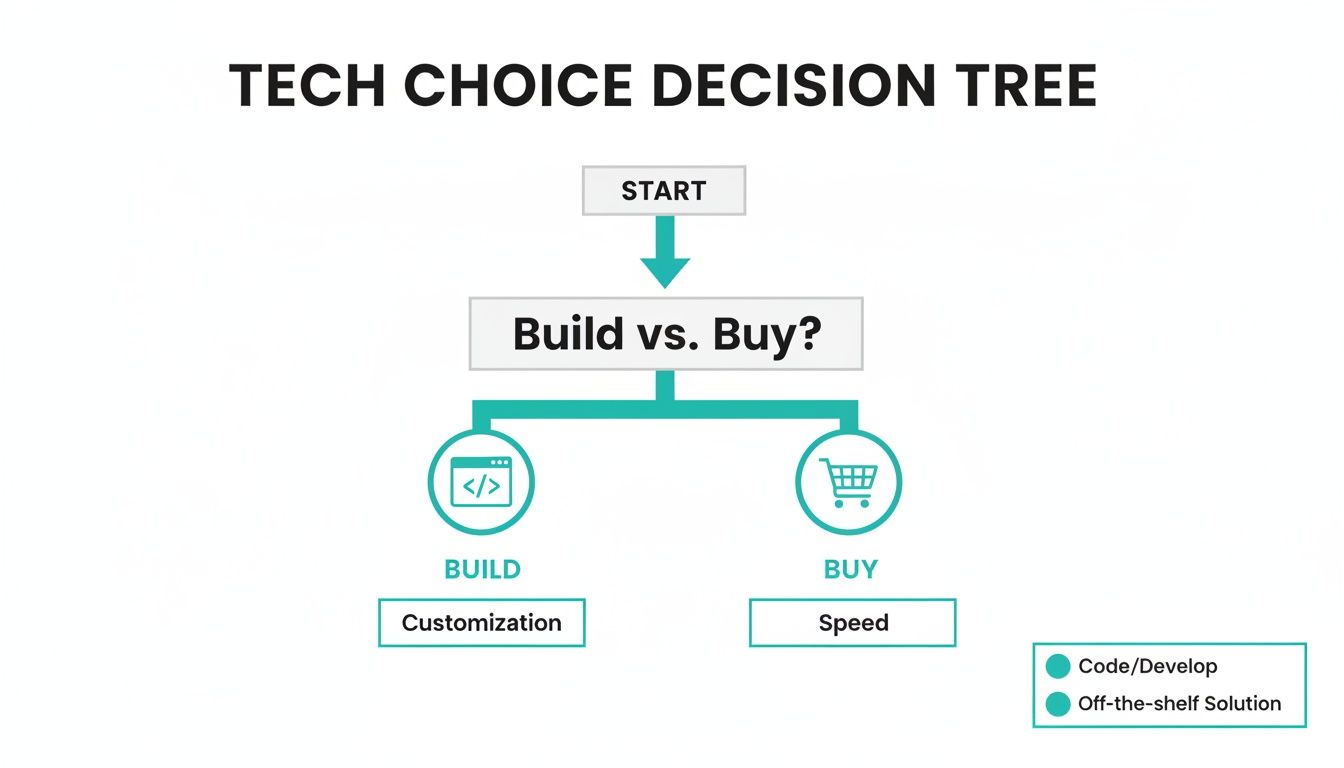
As the visual shows, building makes sense for core, custom solutions that give you a competitive edge. Buying is all about speed and outsourcing problems that aren't unique to your business. A great CTO knows which path to take and when.
As tech leadership roles get more specialized, it's easy to wonder where one job ends and another begins. Getting these distinctions right is key to understanding what a CTO actually does.
While these three roles work closely, they each have a different mission. A practical way to think of it is building and running a city's transportation network.
Deep technical knowledge is just the ticket to get in the door. To succeed in the CTO chair, you need a powerful mix of strategy and leadership.
The explosion of artificial intelligence isn't just a new tool; it's fundamentally rewriting the CTO's job description. Any forward-thinking CTO is now responsible for crafting the company's AI strategy.
The modern CTO must now be the company's chief AI strategist, identifying opportunities to embed machine learning into products, automate internal processes, and navigate the ethical and security challenges that come with this powerful technology.
This expansion means their duties now include establishing data governance policies, building MLOps infrastructure for model training and deployment, and ensuring AI is used responsibly to create tangible business value.
Finding the right tech leader or your next big opportunity starts with the right connections. Underdog.io is a curated hiring marketplace that connects top tech talent with innovative startups and high-growth companies. Stop searching and let opportunities find you. Get started at Underdog.io.